



The Women of Troy - a powerful performance by The Loft
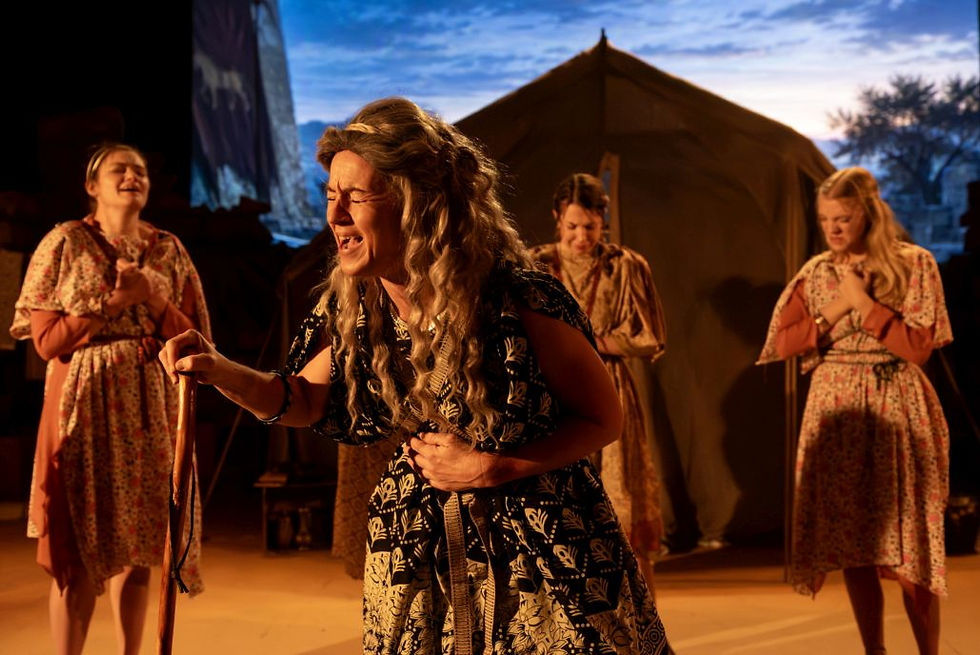
Women of Troy by Euripides, in a new version by David Fletcher. At The Loft Theatre, Leamington, from 28 October to 7 November 2026. Directed by David Fletcher.
Review by Ann Evans
In David Fletcher’s Director’s Notes, he talks about his reasons for wanting to produce this play. Despite it having been written over 2,000 years ago, it resonated powerfully with the conflict and wars going on in the modern world. Not least the continual fighting in the Eukraine following Putin’s invasion, also the ongoing conflict in Gaza. In particular it is the plight of the women and children that spurred David Fletcher on to write and produce this version of Euripides classic Greek tragedy.
David says: “Our virtuoso creative team has, once again, risen to the challenge of crafting a vivid world in which our wonderful cast can explore the profound themes of this play. I am grateful to them all for their brilliant contributions to this production. My version of the text is shorter than the original and its language is, I hope, accessible to modern audiences.”

To be honest, before reviewing this play I wasn’t sure whether I would enjoy a 2,000-year-old Greek tragedy, half expecting the plot and the language to be – well, all Greek to me. But from the very start it proved to be a gripping drama.
The play is set in Troy at the end of a gruelling ten-year war between the Trojans and the invading Greeks – with the Greeks having destroyed the city of Troy. All of the men are dead and the women are about to be shipped back to Greece as slaves, including the former aged and grieving Queen Hecuba (Hannah Grainger-Clemson), whose husband King Priam and sons Hector and Paris are also dead.

It opens with a bang and we’re straight into a scene of war – the noise, the effects, the terror of the Trojan women as their city of Troy is destroyed by the Greeks is dramatic. However, the choreography of the women’s movements, the rhythmic heartbeat sound that is almost like music, grips you.
The women are herded into prison tents and the audience is faced with Greek Gods Poseidon (David Bennett) and Athena (Nadine Batchelor-Hunt). They are angry with the triumphant Greeks who had committed sacrileges against the temples, the innocents and the Gods themselves. Because of this they form an alliance to punish the Greeks on their return home. They decide to conjure up violent storms and raging seas that will decimate their fleets.

The story progresses with the women mourning their menfolk and fearing for their future when Greek messenger, Talthybius (Jonathan Fletcher) comes to tell them what fate awaits them. Hecuba is distraught to learn she is to be the slave of Odysseus who she detests, as he had brought about the fall of her beloved city of Troy – and, as she later learns, has ordered the death of her baby grandson.
Later, a furious Menelaus (Peter Daly-Dickson) arrives, demanding that his wife Helen (Martha Allen-Smith) comes out from hiding and faces him. He fully intends to kill her for being unfaithful to him and causing the Trojan war.

The scene where news comes that Hecuba’s grandson, (son of Hector) is to be thrown from the city walls is one of the most harrowing moments in this play with passionate acting by the baby’s mother, Andromache (Olivia Cunningham). The heartbreak continues when the baby is returned laid out on Hector’s shield to be buried. Clearly, playwright Euripides didn’t pull any punches when writing a tragedy!
However, I think perhaps the most outstanding performance must go to Cassandra, played by Sage Woore. As the daughter of Queen Hecuba and King Priam, when she learns of her fate – to be taken as a concubine by the Greek King Agamemnon, she goes – or acts, insane and does an excellent performance of looking mad, sounding mad and behaving like a mad woman and all set to make Agamemnon regret the day he chose her.

Throughout the play there is some music and singing, with Kleio (Mollie Dibb) as the main singer. Her ballads were sorrowful and haunting and beautifully sung.
The play lasts one hour and twenty minutes, without an interval, and throughout the performance you could have heard a pin drop, with the audience riveted to what was going on. And adding to the drama was the fact that some of the entrances and exits by the characters use the aisles, storming down from the back of the theatre, past the audience and onto the stage, which brought the action very close at times.
Well done to the cast and crew, with special mention to David Fletcher for writing and directing this new version of the ancient play, and the technicians behind the scenes who created such dramatic special effects – the ending being particularly powerful.


Comments