



The Natural Eye 2026 - Society of Wildlife Artists' Annual Exhibition

“The Natural Eye” 2026 – Society of Wildlife Artists’ Annual Exhibition from Thursday 1 October to Saturday 10 October 2026, 10am – 5pm at the Mall Galleries, The Mall, London SW1. (Admission £7. Free for Friends of Mall Galleries and under 25s. No booking required.)
Preview
Great wildlife art begins in the field, with artists often battling inclement weather and challenging conditions to closely observe and experience wild animals, birds and insects at first hand. These nature-based studios often give rise to artists encountering their wild models in the most surprising ways. To mark the opening of the Society of Wildlife Artists’ (SWLA) Annual Exhibition, “The Natural Eye” 2026, five member artists have shared some of their interesting ‘in the field’ stories. The exhibition opens on Thursday 1 October and runs until Saturday 10 October. All work shown will be available to buy online and in-person.
Harriet Mead, President of the SWLA for 16 years - and stepping down after this year’s exhibition - said; “Close observation in the field is the cornerstone of excellence in wildlife art. It is critical both to capturing the spirit of an animal and to depicting it with anatomical accuracy. Working with wild animals in this way can lead to both entertaining and life-enhancing experiences for our artists!”
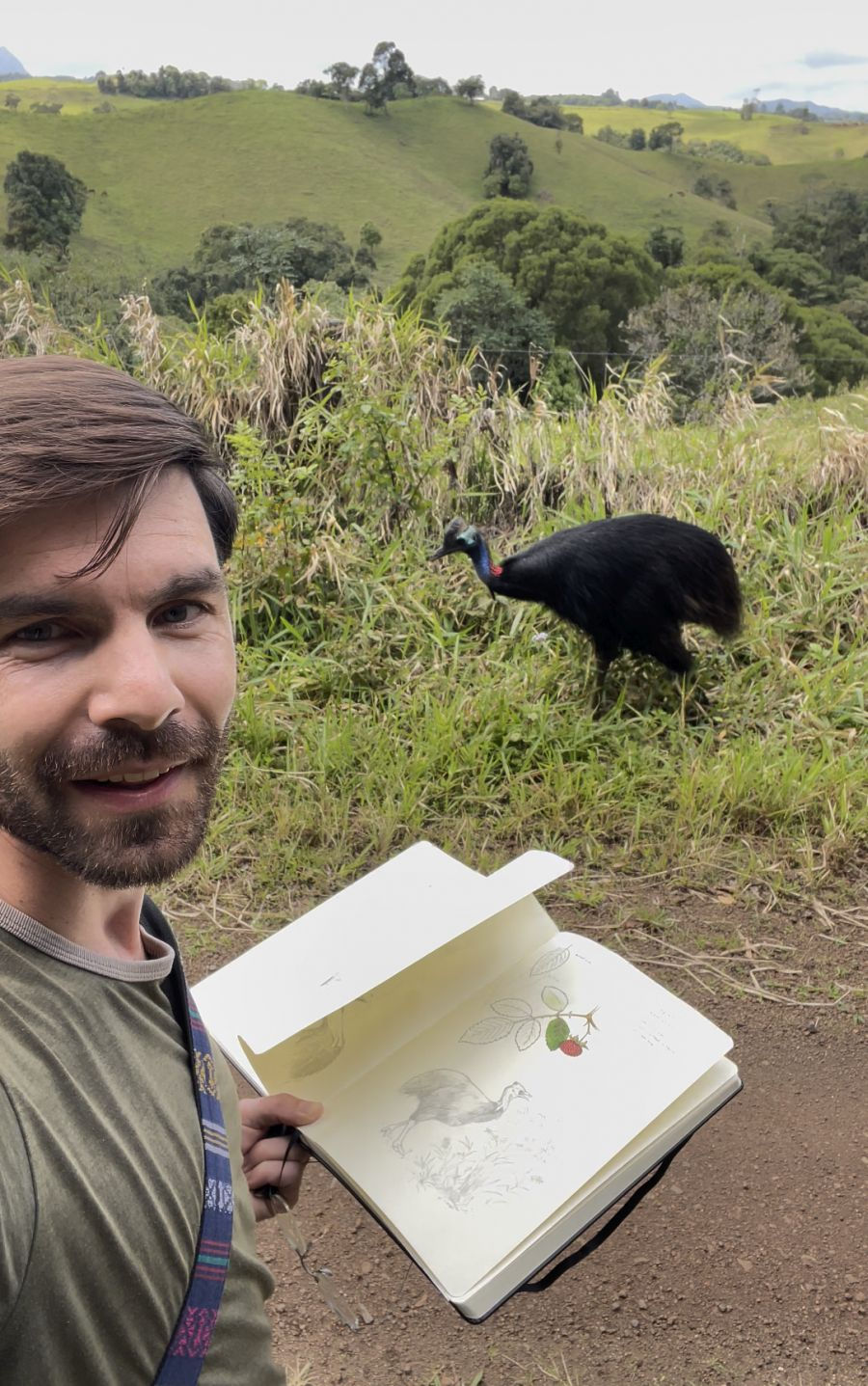
The world’s most dangerous bird sits for a portrait – Joris De Raedt ASWLA
Standing as high as six feet, and weighing up to 160 pounds, Cassowaries are often described as the world’s most dangerous birds. When I was working on illustrations for a biology textbook in Australia, I had already seen how seriously locals treated them. On one occasion, I watched people simply abandon their picnic when a cassowary arrived, rather than risk interfering with the bird. A few years later, I had a close encounter in the Atherton Tablelands. While sketching at the edge of the rainforest, I found myself being chased by a young cassowary. In areas where they are regularly fed by people, cassowaries can begin to associate humans with food, sometimes creating dangerous situations. Fortunately, this one seemed more curious than aggressive. Once the excitement had passed, it lingered nearby and became an unexpectedly cooperative subject for a series of sketches.
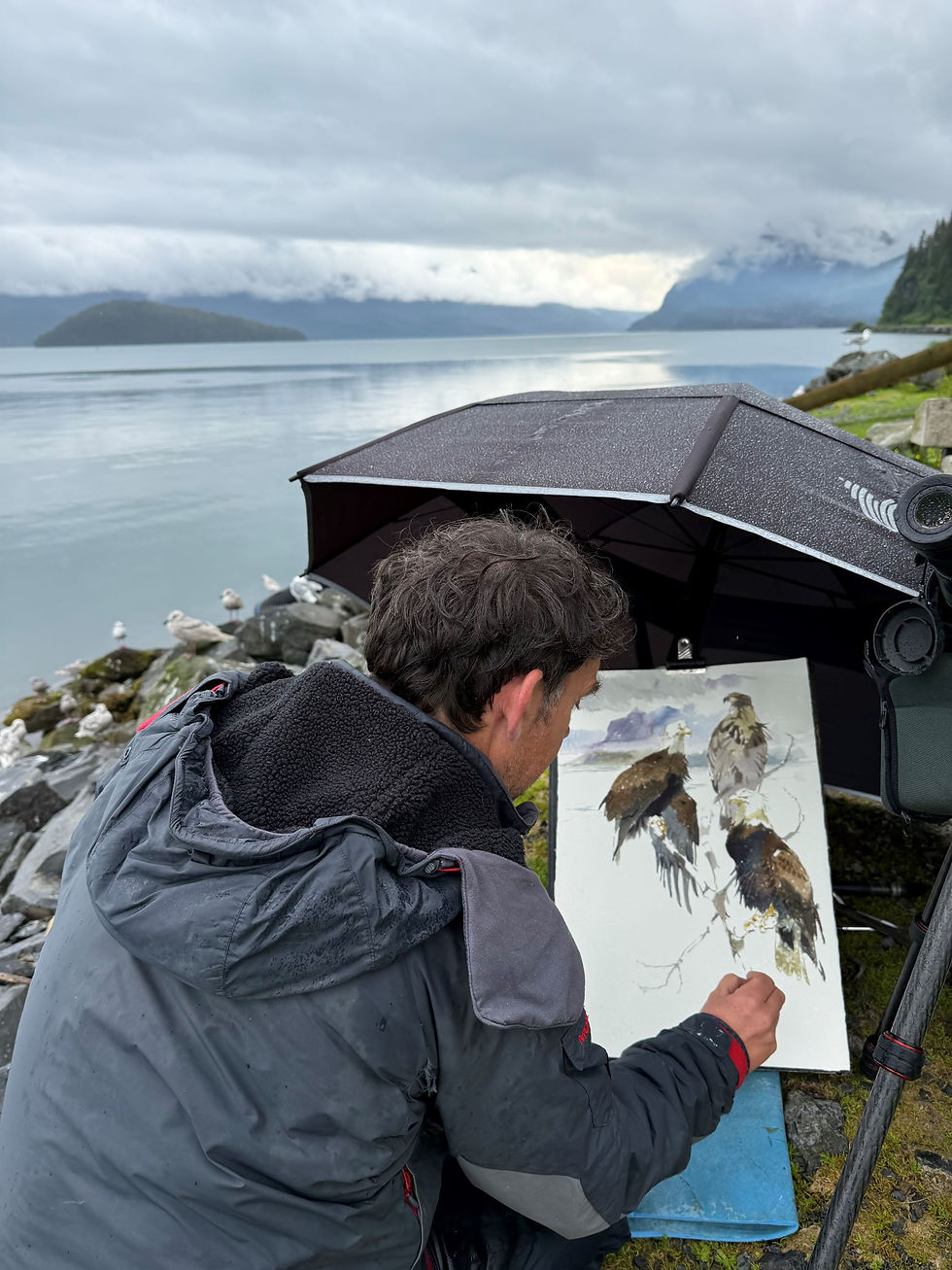
A stoat leaps into my palette – Darren Woodhead SWLA
I had arranged to paint sea eagles snatching Barnacle Geese on Islay with wildlife photographer Jesse Wilkinson. It was a stormy day and my paper was being spattered by rain. Suddenly a young rabbit ran between me and my painting and I saw it was being pursued by a stoat (when I am sitting painting for any length of time I find animals and birds just see me as another object or rock on the landscape.) To get the rabbit, the stoat jumped onto my palette, right into a splodge of yellow ochre paint, used it as a springboard and landed on my painting, before jumping away into the grass. The result was my painting of birds joined with stoat paw prints in 60cm gaps. Amazingly, despite the wind and the rain, the birds weren’t smudged and I now had a completely original work, co-created with a stoat! I have had plenty of other close encounters with wildlife while working in the field – including thrushes hiding under my sketch pads to escape sparrow hawks. My piece in this year’s Annual Exhibition is a nice weathered one which I completed on the Isle of May observing sea birds.

When an adder chooses its mate, 5 minutes away from the home of a wildlife artist – Jane Smith SWLA, Argyll Scotland.
I was out walking with a nine-year-old neighbour near my home when she started screaming and grabbed on to me. When I’d calmed her down enough to talk, she explained that she’d seen a snake in the wall. I looked where she was pointing, but nothing was there. In the following days I went back to look and found a female adder basking in the sun. I was all for relocating the snake as I didn’t want anyone to be bitten, but my husband (who is a wildlife filmmaker) persuaded me that adders are creatures of habit and it was better if we knew where she was. He cleared the path next to the wall so we couldn’t tread on her accidentally, and he placed some logs where she could bask safely. Then one day another snake was curled up with her in the dead bracken - a pale grey male. He stayed just a week to mate with her - long enough for me to make sketches for a picture. By watching them regularly we’ve learned so much about adder behaviour. Although I still have a healthy respect for the danger they pose, I feel privileged to have this window into the life of such a rare and little-known creature. My screenprint of the adders will be in the SWLA’s Natural Eye exhibition this year.
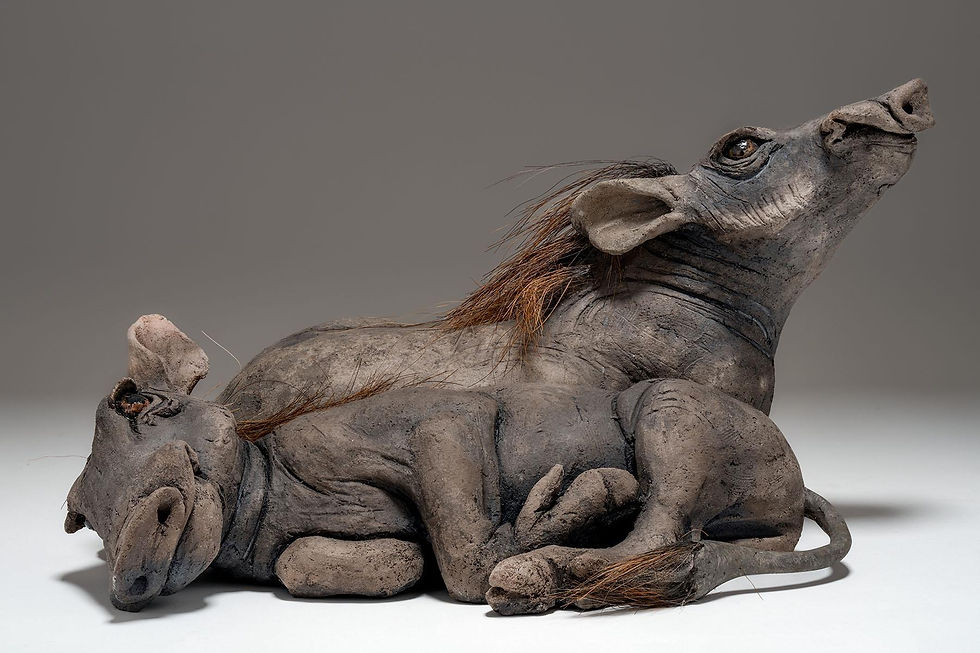
Family of warthogs – they felt so comfortable, the babies joined too – Nick Mackman SWLA
I am exhibiting sculptures of warthog babies at this year’s Annual Exhibition, based on an amazing experience on my last Zambia trip. It was sunrise in South Luangwa National Park. We came upon a sleeping family of warthogs, lying exposed in a large open space. We approached quietly and respectfully, and even though the adults saw us, they were unbothered and remained relaxed. This in turn allowed the babies to continue to rest (usually they are very hard to see.) Every now and then a baby would pop its head up because they could smell us, look concerned but then settle back down again. It was such a privilege to spend a few minutes with these charismatic animals in such a peaceful yet vulnerable position. Keeping those ideas in mind I was inspired to sculpt a group of baby warties. I explored how they are aware of both their environment and potential threats, as well as their family around them. I use horsehair for their manes to draw emphasis to their most visual form of communication and their skinny tails are made of metal.

Sketching underwater where fish swim upside down - Dafila Scott SWLA
I was snorkelling beside the most beautiful overhanging wall which formed the side of a small tropical island. There were so many stunning colours and so many different fish. Suddenly I realised that some of the fish were swimming upside down against the roof of the overhang - mostly the orangey anthias fish, so I stayed to watch them and all the other fabulous fish: the keyhole angel fish, the soldier fish and squirrel fish and my favourite, the very long nosed butterfly fish. Then I realised I was so engrossed, I needed to swim like mad to keep up with my snorkelling buddies. I arrived panting back at the boat with my drawing pad full of sketches.

I paint wild dogs in Africa but this spring, the wildlife came to my back garden - John Dobbs, SWLA, Rickmansworth.
Working from life is extremely important. I look at the movement patterns of wildlife. Their structure, how the animals moves and their bone structure. Now living in Rickmansworth I have a garden and lots of badgers, foxes, deer come into the garden so constantly able to draw and paint from life. In spring this year, one of the old holes on the other side of the garden had been dug out and a young fox Vixen had made a den and she had five cubs. I spent the next month just drawing fox cubs in the garden. Paintings from this magical (and highly convenient!) observation will be in this year’s Annual Exhibition.
Other highlights of the exhibition include:
Over 360 original works of art including painting, drawing, sculpture and printmaking inspired by the natural world, available to buy.
Fieldwork and sketchbooks revealing the artists’ in the field and creative processes.
Special events including artist talks, demonstrations and the opportunity to meet exhibiting artists.


Comments