



After Party: Death, divas and die-hard repression

After Party by Morna Young at the Belgrade Theatre until 11 September 2026
Review by Amanda Burden
This week I have been lucky enough to review two shows about hard-living celebrities contemplating their own demise.
The first was the true story of Dr Feelgood guitarist Wilko Johnson. The second is the fictional actress Vivienne Blackwood in Morna Young’s After Party, directed by Katie Posner and currently at the Belgrade Theatre.
Both begin with a terminal cancer diagnosis and the same seismic quandary: if the end is coming, how do you want to meet it?
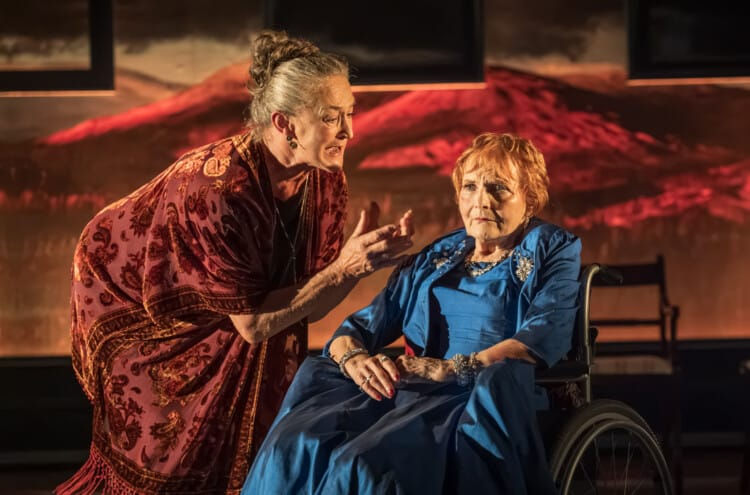
While Johnson ultimately allowed nature to take its course, Vivienne has other ideas. She intends to end her life on her own terms, in her own country pile in Scotland, set in a near future where assisted dying has become possible. Simple, you might think.
Absolutely not. Because Vivienne has invited the family for one last knees-up before she departs.
Vivienne, played by Alison Peebles, is the ageing alcoholic film star celebrating her 80th birthday, surrounded by her family, who love her, resent her, need her, want her money or, in some cases, all five.
Her ex-husband Bill (Benny Young) is a flamboyant, bohemian film director. Their relationship is tempestuous, theatrical and bonkers, but beneath the bickering is genuine affection and an infectious joie de vivre — think a Highlands Liz Taylor and Richard Burton.

Her children and grandchildren are peppered with all-too-recognisable stereotypes. Son Geoff (Gilly Gilchrist) is arrogant, pompous and spectacularly self-entitled, with all the bluster and beef of a man who blatantly divided up the family estate before his mother’s cancer was even on the cards. Meanwhile, daughter Lily (Hilary Maclean) is the polar opposite — intensely religious, but her brittle, shrewlike piety hides a character strata layered with disappointment, repression and fear.
And grandchildren James and Sasha are poster children for the millennial generation. James is played by Angus Yellowlees to vulnerable new-man perfection, all blinky-eyed ingénue, landing somewhere between Elijah Wood’s Frodo and a young James McEvoy. Sasha (Rachel Dick) is an influencer — what else? — whose obsession with curating the perfect online lifestyle belies her longing for a genuine family connection.
James’ American singer fiancée Cass (Ruby Glyne), abruptly thrust into the seething hotbed of emotion concealed by buttoned-up respectability, is genuinely bemused. My American friend, who moved to Britain after marrying her English doctor husband, once commented — with similar confusion — that the defining characteristic of the British is that nobody says what they mean.

I feel Cass would like this embroidered on a cushion. Everyone in After Party has something to say about Vivienne’s decision, but almost nobody expresses the thing they actually want to say. This is where the production’s extraordinary hotchpotch of cultural references makes sense.
Riot grrrl punk rubs shoulders with Shakespeare and Chaucer. High-camp musical theatre collides with Frank Sinatra and traditional Scottish folk. The language darts from poetic to profane, from classical to contemporary — it is a jumble, but it works. This is not a play about one person facing death, but a play about everyone facing death. The diverse cultural references mirror the family members: a glorious, argumentative, contradictory melodrama of people who have nothing in common but still must grapple with the same enduring questions — how much control should we have over death, what does love require, and ultimately, can you disagree with someone’s decision but still respect it?
This is perfectly embodied in one of the final scenes, where former daughter-in-law Carol, pruning roses in the garden, reflects on how flowers can be beautiful, prickly and hardy — some thrive in shade, others embrace the sun. Nicely done, play.
This observation captures the fundamental core of After Party. People are contradictory. Families are complicated. Death is the great leveller, catching us no matter how far and fast we run. But above all, love — while inexplicable, painful and sometimes infuriating — is as hardy and enduring as the roses in Vivienne’s garden.
For tickets go to: https://www.belgrade.co.uk/events/after-party/


Comments